Where did your secondment take place and what did it involve?
I completed my secondment at ChemSec (the International Chemical Secretariat) between 13 October 2025 and 9 January 2026. During this period, I supported ChemSec’s research and advocacy initiatives on sustainable chemistry, including literature review, data collection and analysis, and policy review. ChemSec is an independent non-profit environmental organisation that works to drive the transition toward safer, more sustainable chemicals in society. They advocate for the substitution of hazardous chemicals with safer alternatives, influence chemical policy and legislation, and develop research-based tools and guidance used by regulators, companies and investors worldwide.
What are the main skills you have gained or developed during your secondment?
During my secondment, I further developed both my technical and professional skills as a toxicologist working at the interface of science, policy, and advocacy. As a toxicologist, I have always been motivated to contribute to work that aims to ensure chemical safety while protecting both human health and the environment. For this reason, I had long followed ChemSec’s activities closely and was highly motivated to undertake my secondment there. As an academic, I greatly enjoyed contributing to the tasks assigned during the secondment. While conducting literature reviews is a familiar part of academic work, this experience allowed me to approach the literature from a different perspective, focusing on policy relevance and real-world impact. Seeing how scientific evidence shapes projects and advocacy efforts outside academia, and working alongside toxicologists in non-academic settings, was a particularly valuable learning experience for me. In addition, participating in ChemSec’s event “From SIN to WIN – A Compass for a Clean and Competitive Europe!”, held in Brussels on 14 October 2025, helped me strengthen my understanding of how chemical pollution, material flows, the SIN List, and REACH regulation are discussed across science, industry, finance, and EU policymaking. Engaging with experts from the European Parliament, industry, academia, and civil society enhanced my skills in interdisciplinary communication, policy analysis, and stakeholder engagement within the context of sustainable chemistry and the circular economy.
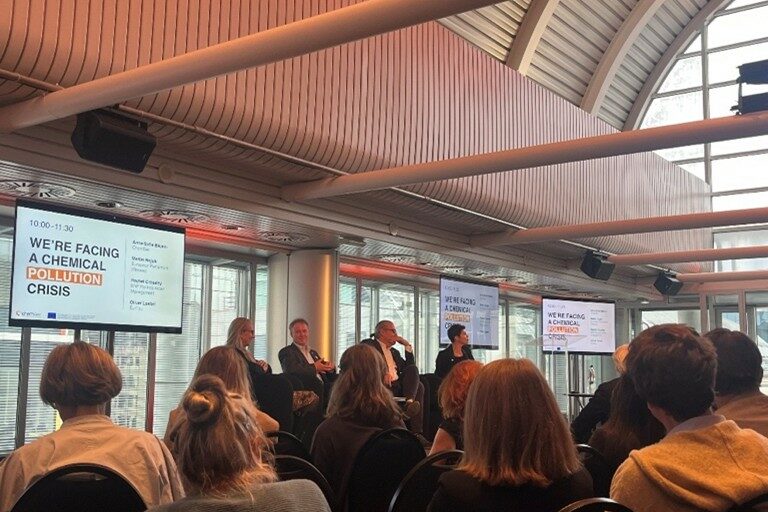
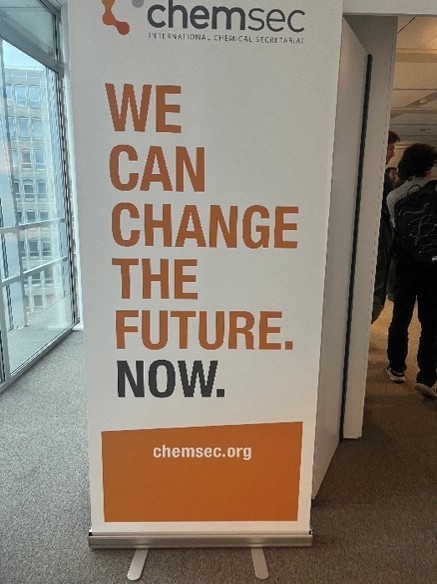
| Image taken during the ChemSec event From SIN to WIN – A Compass for a Clean and Competitive Europe, Brussels, 14 October 2025. |
Were there any surprising or challenging aspects?
One of the most interesting aspects of my secondment was seeing how academic knowledge and research are applied in a real-world policy and advocacy context. While literature reviews and data analysis are familiar tasks in academia, I realized that communicating this information to a general audience requires a very different approach. The language and style used outside of academic writing were quite different, which was a surprising aspect of the experience.